 Evmos
Evmos on Cosmos after its mainnet shutdown
Evmos ran Ethereum-compatible smart contracts on a Cosmos blockchain until the shutdown of its mainnet. Its design combined the Ethereum Virtual Machine (EVM), which executes contract code, with Cosmos infrastructure and Inter-Blockchain Communication (IBC). Developers could deploy applications, while users could manage cross-chain tokens through Assets or use the Staking and Governance applications. The related evmOS name describes a software stack for building EVM chains.
Shared contract tooling reduced the work of adapting an application to this network. Cross-chain transfers depended on their own connections. The shutdown later ended normal mainnet execution, even though software, documentation, and saved network settings could remain accessible.
Key takeaway: EVM compatibility described contract execution; transferring assets between networks also required a supported connection and transfer mechanism.
Ethereum contract code on a separate Cosmos chain
EVM compatibility allowed Solidity contracts to execute on this network using familiar Ethereum development tools and interfaces. Developers could retain an application’s contract language while choosing a different blockchain for execution and use Ethereum JSON-RPC to deploy and interact with its contracts, although chain-specific dependencies still needed support on the destination network. The deployment still had its own contract state. Reusing code did not copy an application’s existing balances or liquidity from Ethereum.
Cosmos infrastructure beneath the contract environment
Cosmos SDK modules and CometBFT consensus supplied the underlying infrastructure for the network’s Ethereum-compatible contract environment.
Cosmos SDK modules
The Cosmos SDK provided the framework for native blockchain functions alongside contract execution. Stateful precompiled contracts, known as EVM Extensions, let application code invoke native operations such as staking and governance, so a smart contract could change the relevant Cosmos SDK module state through its EVM interface.
CometBFT consensus
Validators participated in consensus and committed new blocks. The EVM determined how contract code executed; validator agreement established the blockchain’s accepted sequence of transactions. Ethereum compatibility did not move the responsibility for committing those transactions onto Ethereum’s validators.
Did EVM compatibility automatically provide transfers from Ethereum?
EVM compatibility enabled contract execution, while moving assets between Ethereum and a separate chain required an applicable transfer mechanism. IBC enabled communication between compatible blockchains. Within the Cosmos architecture, that capability supported cross-chain applications and token movement. A usable transfer still depended on the relevant connection, supported operation, and asset representation. Shared programming tools alone did not create those connections or determine which assets a route could carry.
EVMOS in fees, staking, and governance
EVMOS was the native token used in the network’s fee and staking systems before the mainnet shutdown.
Transaction fees
Transaction fees paid for network execution. Gas represented computational work, so an operation’s complexity mattered to its cost. Archived gas-price settings described the former configuration. They do not provide a present transaction quote for an operating mainnet.
Validator delegation
Token holders could delegate staking tokens to validator candidates. Stake helped determine participation in the active validator set, connecting token delegation with the network’s security. Validators and delegators earned protocol rewards while the network operated. Delegated stake also faced protocol penalties for validator misconduct, including double signing. Those mechanics did not create a fixed investment return.
Governance participation
Governance gave token holders a way to participate in decisions affecting the chain. This role concerned network rules and proposals, separate from executing an application’s contract logic. The shutdown record identified a governance proposal as part of the chain’s halt.
The evmOS stack and release-specific software terms
The chain was the flagship implementation of evmOS, a software stack for building compatible EVMs. The stack addressed how to construct an EVM environment, while the mainnet supplied one particular ledger and validator network. The code described contract execution and native module integration independently of that deployment’s operating status.
Software reuse also depended on the release’s licensing terms. Version 13 and later used Evmos Non-Commercial License 1.0, with specified files retaining LGPLv3. Earlier releases retained LGPLv3. Public access to the repository therefore did not give every release identical commercial permissions, and those code-use conditions concerned a different question from an application’s ability to execute on a running chain.
What did the mainnet shutdown change?
The shutdown ended normal mainnet transaction processing, changing the practical relevance of older deployment, transfer, and reward instructions. Contracts needed validators to commit transactions. Signing a request or submitting it through a wallet could not replace that consensus process.
The Cosmos Chain Registry marked mainnet evmos_9001-2 as "killed" in the change merged on June 3, 2026. The accompanying change record placed the halt around May 18, 2026. That approximate halt date described the reported chain event; June 3 identified the registry update. The same record reported a halt near block 37318000. Older documentation could still explain contract interfaces and historical settings. A visible application or saved network entry, however, did not establish a functioning transaction service.
Native staking rewards depended on the running chain’s block and reward mechanisms. A displayed historical yield did not establish continuing reward accrual.
Archived mainnet settings
The retained mainnet configuration identifies the original network, its software release, and the infrastructure it once used.
The registry retained codebase information, consensus details, and service listings alongside the shutdown status. An archived recommended release identifies software associated with that deployment. It does not certify a working public endpoint or turn preserved setup instructions into an available mainnet service.
Conditions behind the former network’s capabilities
- For a historical mainnet record, match network identifier evmos_9001-2 before interpreting its balances or transactions.
- For contract behavior, distinguish EVM execution from the Cosmos modules an EVM Extension calls.
- For a cross-chain capability, identify the connection and asset support the transfer mechanism required.
- For software reuse, match the license to the release and any file-specific exception.
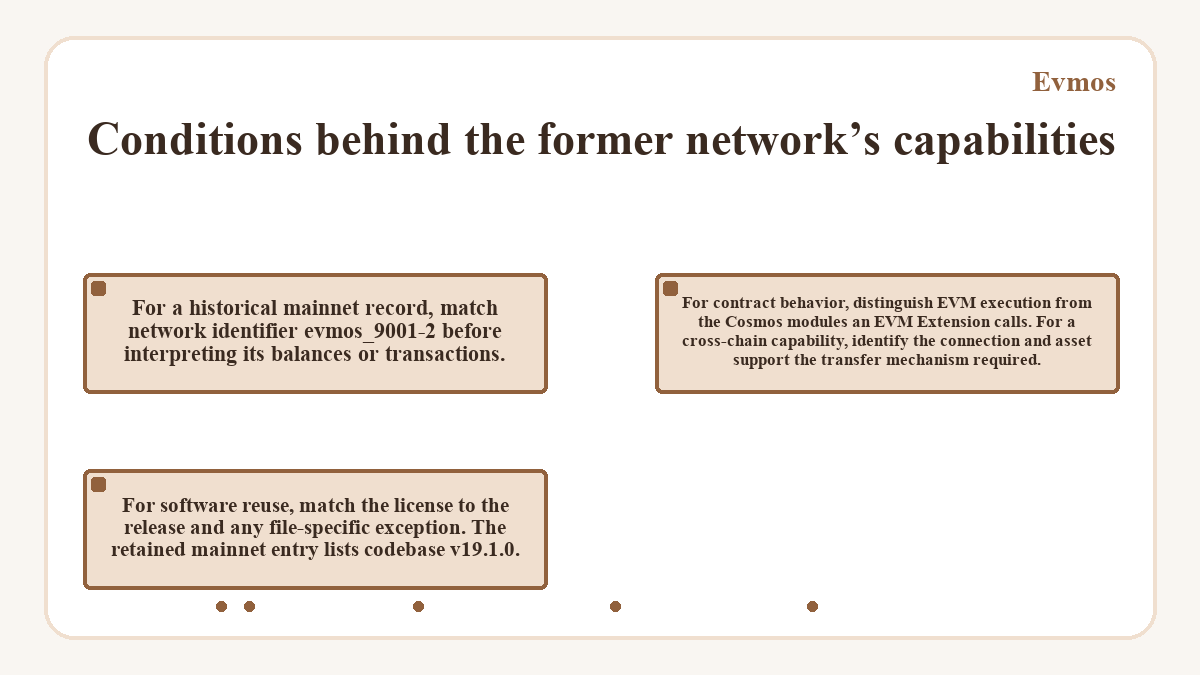
The retained mainnet entry lists codebase v19.1.0.
Evmos: reader questions
-
What did aevmos mean in the network configuration?
- aevmos was the denomination the registry specified for both transaction fees and staking. That spelling identified the unit used in those chain configuration fields. It was not a quoted fee amount or a staking return. The archived gas-price entries also belonged to the former network configuration, so they do not establish present transaction availability.
-
Which version 13 files retained LGPLv3?
- The exceptions were x/erc20/keeper/proposals.go and x/erc20/types/utils.go. The repository’s licensing statement kept those files under LGPLv3 while applying Evmos Non-Commercial License 1.0 to version 13 and later. Older releases retained LGPLv3. A file-specific exception did not extend automatically to the remaining codebase.
-
Could contract verification establish an application’s security?
- Contract verification matched published source code with deployed bytecode; it did not certify an application’s security. That match helped identify the program a user was interacting with. It did not establish freedom from coding errors or safe application economics. Historical verification also said nothing about whether the underlying network remained operational.
-
Does the shutdown determine the outcome for an exchange-held EVMOS balance?
- The mainnet shutdown alone does not determine how an external exchange handles an EVMOS account balance. An exchange maintains its own accounting and applies its own terms for trading, withdrawals, or settlement. The chain’s operating status does not establish a conversion entitlement or a payout amount for holdings on another platform.
-
Was there a Windows build in the retained mainnet configuration?
- The retained registry entry listed a Windows amd64 binary for v19.1.0, alongside Linux and macOS builds. The historical validator documentation separately named macOS and Linux as supported systems. The package listing and validator guidance answered different questions; neither established present mainnet availability or confirmed a particular download still worked.
-
Can running evmosd locally restart the original mainnet?
- A local evmosd process cannot restart the original mainnet by itself. The public network required participating validators to agree on blocks. Local development concerns a separate execution environment, so starting a local node does not resume the original chain’s transaction processing.